I like to think that I am a good listener, and before diving into “Deep Listening, A Composer’s Sound Practice,” I thought I had a pretty good grasp of what deep listening meant. I realized soon after starting that my interpretation was different from Pauline Oliveros’. According to her, “deep listening is a practice that is intended to heighten and expand consciousness of sound in as many dimensions of awareness and attentional dynamics as humanly possible.” Hearing and listening are two different things; the words themselves may be used interchangeably, but hearing is simply the physical act of noticing sounds while listening is intently interpreting those sounds and making sense of them through context, experiences, etc.
Deep listening also acts as “a form of meditation,” which led me to explore 3 of the exercises highlighted in the text: arm swinging, breath regulation and listening. I felt the tension within my body leave shortly after the arm swinging started (I also do this regularly in my own time), and breath regulation reminded me of the box breathing exercises I adopted years ago. I tend to get in my head a lot, so the breathing exercises absolutely help/ed me bring my consciousness back to center. During the listening exercise, I found myself inadvertently doing box breathing again; I don’t think that was the intent, but it also helped in me gaining focus and intentionally seeking out sounds to focus on. These exercises did a great job of putting me in a space to respond to the gift I received from my IMA Low-Res cohort member Mimi as well.
Mimi’s gift was a collection of quotes, passages and readings that centered around this idea of social anxiety, performance, and surveillance, all of which can be argued as getting in the way of humans tapping into their primitiveness and acting on their natural instincts. She talked to me about this idea of subject/object philosophy and how it can only exist if there’s an observer. I thought it was interesting because I can say that social anxiety has been something I’ve struggled with (hence me also being privy to the deep listening exercises I mentioned above—they help!) Us humans were, at some point, unashamed of being human and making mistakes, but this notion of surveillance and being captured on camera has caused the collective to be hyper aware of how we’re being perceived, thus causing us to be anxious about staying in line.
While engaging with the gift, I wanted to honor that notion of surveillance keeping us “in line” and scared to stand out in a way that felt true to me, but I also want to acknowledge that “staying in line” and being appropriate to society’s standards have likely always been a thing. Before modern civilization, I’m sure villagers stayed in line because they didn’t want other members in their village to think poorly of them. The need to want to fit in with a group is innately human, but I think the permanence of video and social media and the Internet in general has heightened our desire to stay under the radar.
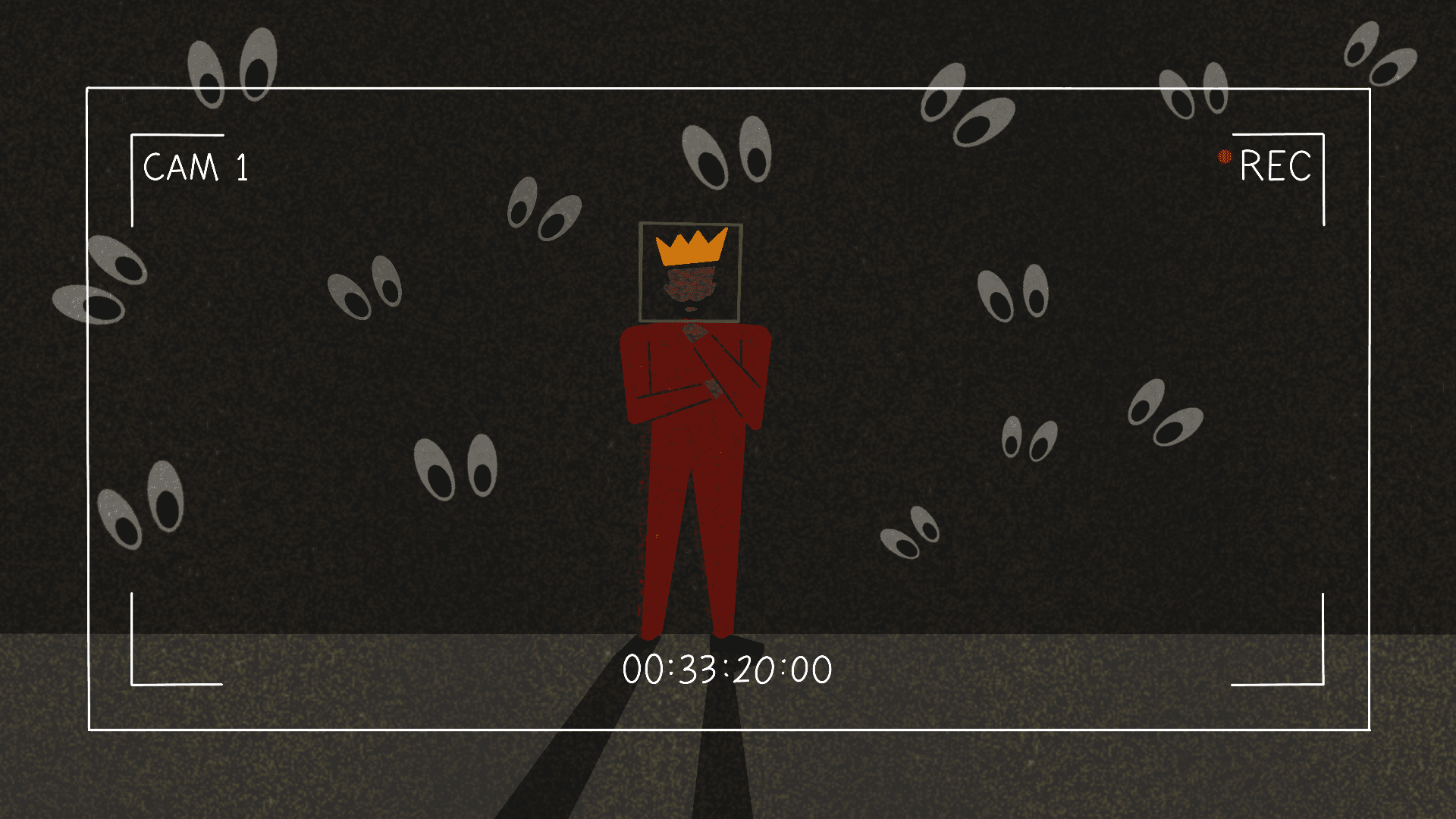
With this in mind, I illustrated a scene, titled “Social Anxiety Don’t Live Here,” that merged the ideas of surveillance, confidence and standing out together. In it, the subject was likely somebody who struggled with social anxiety at some point, but he’s now comfortable being the center of attention while still being perceived by those around him. The artistic choices were intentional: the red suit speaks to his confidence, the crown speaks to him being the center of attention, the eyes represent society perceiving him, and the surveillance camera represents Big Brother/government/law enforcement.

I chose illustration because that was immediately what my brain/hands wanted to do, and I also thought it gave me the freedom to depict social anxiety (and overcoming it) in an interesting way. It felt meaningful to do it using this medium because the idea of social anxiety resonates with me; it felt like a direct time-in into my experience, so illustrating it via Procreate just felt right. Color, size, saturation and composition were key in depicting what bubbled up from really engaging with Mimi’s gift. If I had more time and to make my subject stand out even more, I’d likely spend more time drawing actual people to fill the canvas and illustrate those subjects as dull, lifeless robots. I think that juxtaposition would make the illustration that much more interesting.
References:
“Double Quadruple Etc 1” by Sandra Perry:
https://www.moma.org/collection/works/428542“We Have Never Been Modern” by Bruno Latour:
https://www.hup.harvard.edu/books/9780674076747“Doors of Perception” by Aldous Huxley:
https://maps.org/images/pdf/books/HuxleyA1954TheDoorsOfPerception.pdf“Magic, Science, Religion” by Bronislaw Malinowski:
https://monoskop.org/images/4/41/Malinowski_Bronislaw_Magic_Science_and_Religion_and_Other_Essays_1948.pdf“Intimations” by Zadie Smith:
https://www.goodreads.com/en/book/show/53825991-intimations
© 2019-2026 Marshall Creative Group LLC
Studio