YETI Map The Gaps
Experience Case Study
Overview
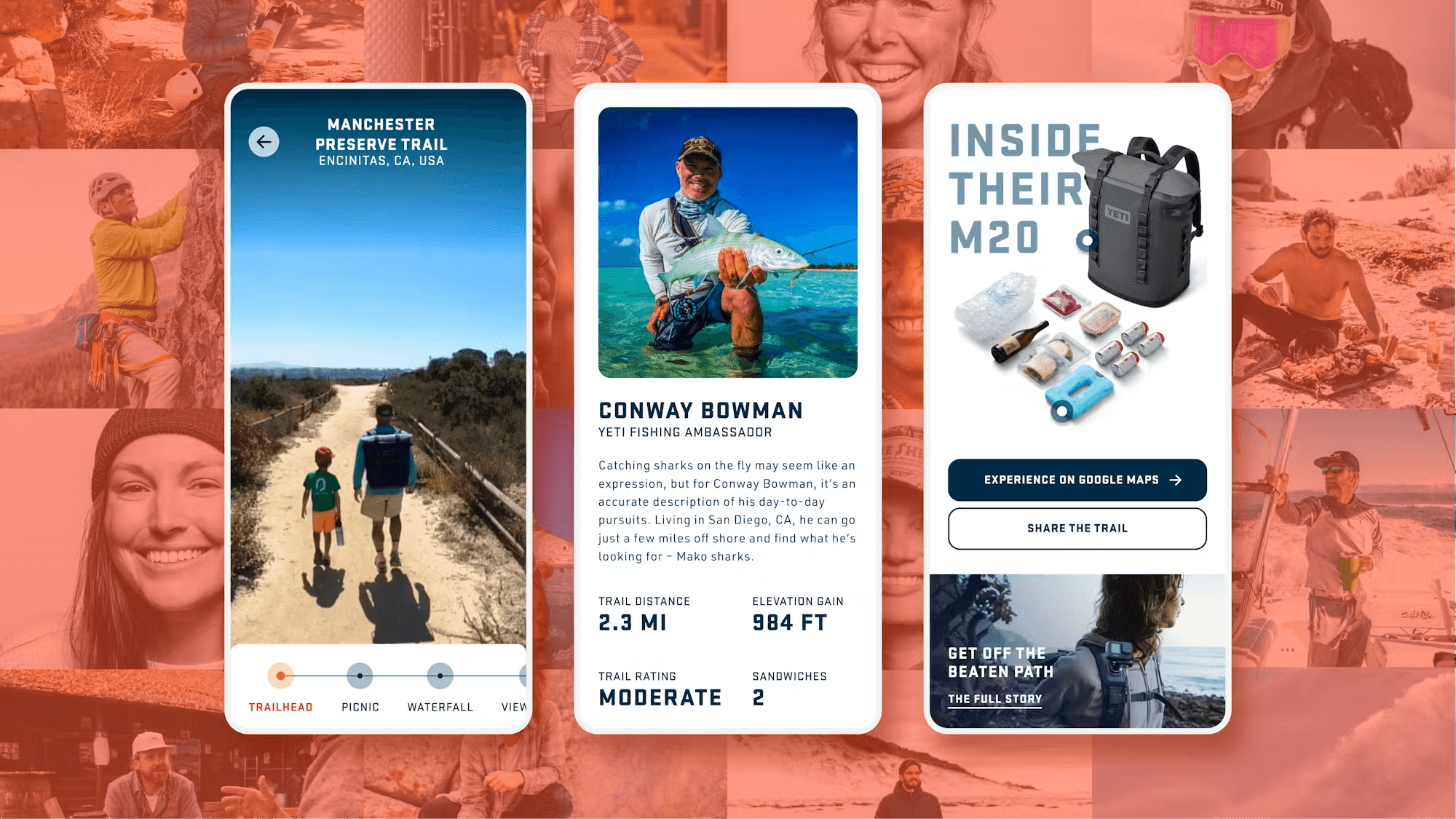
YETI’s Map The Gaps is a pioneering digital experience that reimagined how a brand can connect adventurous audiences with the outdoors. By leveraging Google Street View’s open API, the experience brought uncharted wilderness trails into a discoverable interactive platform — inspiring exploration and positioning YETI’s Hopper M20 cooler at the heart of real expeditions.
Role
Associate Director of Product Management
Company
Code & Theory
Client
YETI
Timeline
Design, development and launch took ~5 months (2024)
My Contribution
I led the product strategy and execution for the digital experience that served as the keystone of the campaign — from vision and roadmap to launch and optimization.
The Challenge
Google Street View covers 98% of the world’s mapped surfaces via roads, but remote trails and unpaved paths remain absent from the mainstream mapping experience.
YETI saw this gap as both a brand opportunity and a product storytelling challenge: how to build a digital experience that
authentically connects with explorers,
showcases the Hopper M20 in its element,
increases accessibility to wilderness exploration,
and does so in a way that is technically innovative, scalable, and inclusive.
Strategy & Product Vision
To achieve this, we centered the product around three core pillars:
1. Explore the Unmapped
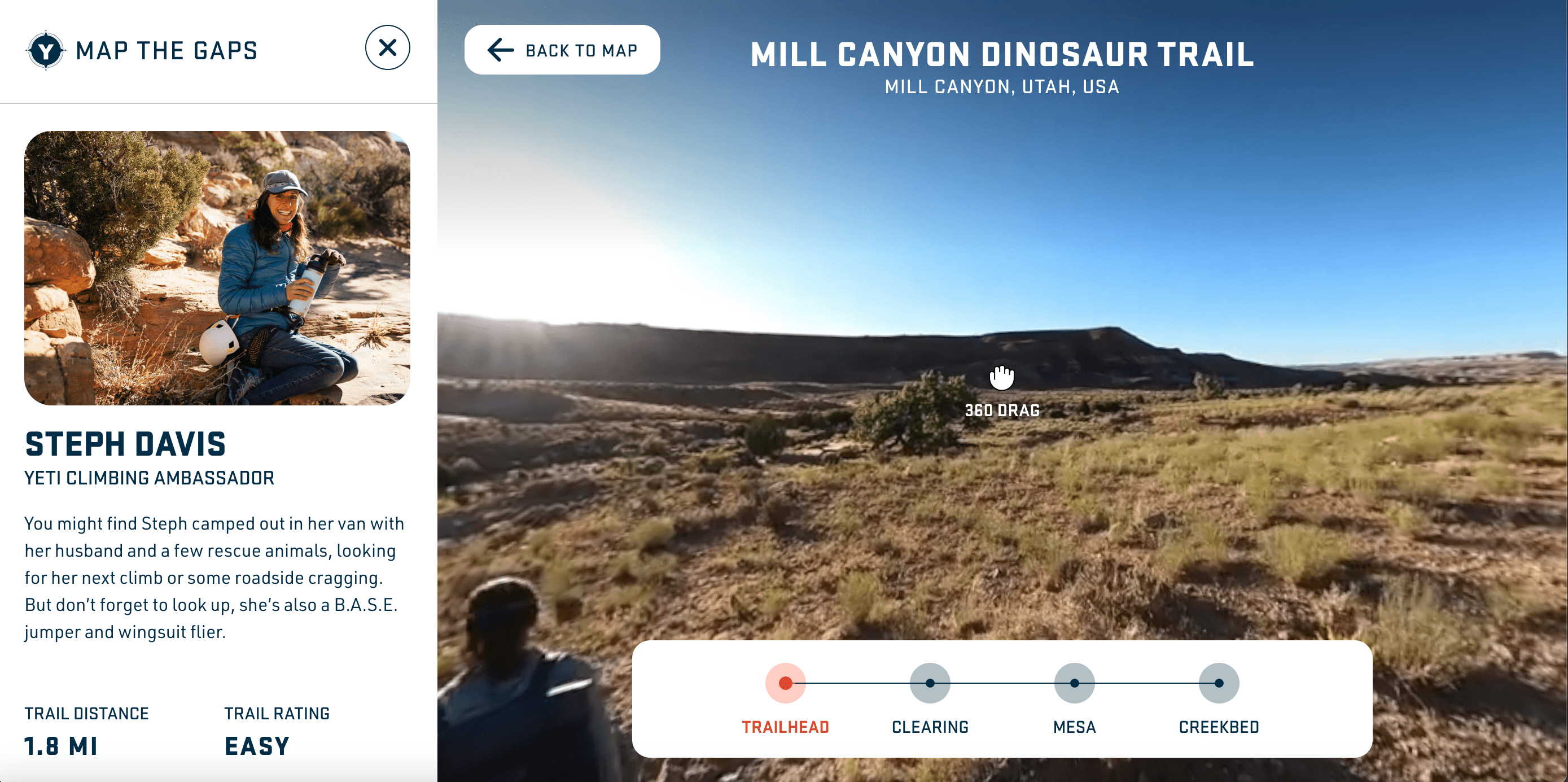
We conceptualized an immersive platform where users could virtually traverse real trails that hadn’t been on Google Street View — leveraging 360° footage captured by YETI ambassadors — and preview paths before adventuring themselves.
2. Accessible by Design
Accessibility wasn’t an afterthought. Our experience adhered to WCAG AA guidelines, ensuring that screen readers, clear landmark labeling, keyboard navigation, and motion-sensitive modes were baked into the interface.
3. Seamless Integration
Rather than a separate microsite, we engineered the product to transform Google Street View into an organic showcase for explorers and for YETI alike — turning a familiar tool into a discovery engine.
My Role & Responsibilities
Defining Strategy & Roadmapping
Led cross-functional discovery workshops with designers, engineers, and YETI’s internal team to align on product goals and KPIs; defined MVP features.
User Journeys & Experience Specifications
Mapped end-to-end user flows from planning to exploration, ensuring intuitive UX.
Collaborated with UX designers to prototype and iterate with stakeholders.
Technical Integration Oversight
Partnered with engineers and technical leads to scope the integration with Google Street View APIs and ensure scalable data handling of 360° video content.
Prioritized infrastructure needs (React, Firebase, Cloudflare) for rapid performance and global responsiveness.
Accessibility Leadership
Ensured accessibility standards were integrated into acceptance criteria and QA cycles — including motion reduction controls and assistive navigation support.
Data & Optimization
Coordinated analytics instrumentation to track user engagement, video interaction metrics, and conversion impact.
Drew insights for post-launch enhancements.
The Experience
The interface allows them to:
Browse a global map of newly charted trails (15+ total).
Explore immersive 360° trail walkthroughs, pan and zoom into key waypoints, and experience the trail as if onsite.
Access via multiple devices with responsive performance — from desktop to mobile.
Plan real world adventures with intuitive navigation and trail context.
Behind the scenes, we built a modular system enabling YETI — or even users in the future — to add new trails simply by uploading footage to Google Street View, democratizing the mapping process.
Accessibility as Design Research
Designing for WCAG AA compliance fundamentally shaped the product's interaction model. Screen reader testing revealed that our initial navigation structure treated the map as the primary interface, making it incomprehensible to non-sighted users. This pushed us to redesign information hierarchy so that trails could be discovered and explored through multiple pathways: visual map browsing, list-based navigation, and keyboard-only interaction.
Motion sensitivity controls also surfaced an unexpected insight: many users (not just those with vestibular disorders) preferred reduced motion when focusing on trail details, suggesting that stillness aids comprehension even for immersive content. This challenged our assumption that 360° video required constant movement to feel engaging.
These constraints improved the experience for all users, not just those requiring assistive technology.
Results & Impact
The experience had both brand and business impact:
+300% increase in Hopper M20 sales post-launch
1B+ monthly users accessed through Google API reach
78M+ media impressions from major press including Forbes, Ad Age, Gear Junkie, and The Drum
75+ miles of remote trails added to public view — transforming a product campaign into a public utility
3x Gold Winner in The Drum Awards for Marketing, Webby Award Winner for Best Use of Online Media, Merit Winner in The One Show and ADC
Ready for what’s next?
Let’s talk about your next project—no pressure, just conversation.
Get in touch
© 2019-2026 Marshall Creative Group LLC
Studio