
PROJECT OVERVIEW
What It Is
What started as a personal passion project, Them Old Ideas Are Buried Here is a research-driven illustration publication based on Beyoncé’s 2024 studio album, Cowboy Carter. When I listen to it, a Western film unfolds in my mind. This project is an attempt to honor that vision: an illustrated interpretation of the album’s narrative, told as a sequence of standalone scenes that mimic classic Western films of the 20th century. It uses the album narrative to reexamine the mythology of the American West by centering the Western frontier during the Old West times, Black-founded frontier towns, overlooked histories, and cultural memory.
Similar to contributions made to Country music by Black musicians, popular depictions of the Western frontier often erase Black presence or flatten it into symbolism without authorship. This project responds by anchoring narrative, music, and geography into a single visual system, and aims to contextualize Black lives outside of the slavery or Jim Crow contexts of the late 19th and early to mid-20th centuries.
Why It Exists
Cowboy Carter was released without a visual accompaniment; selfishly, I was inspired to create my own. On a more macro level, this project aims to fill a gap as labels have become seemingly more risk-averse when it comes to marketing and promoting music in today’s streaming era.
Made popular by Michael Jackson’s “Thriller” in the 80s and gaining popularity throughout the 90s, 00s, and 10s, music videos have been integral in the promotion stack for recording artists. However, MTV has since exited the music programming business, and the decline in music profits and attention spans has shifted labels away from big budget music videos.
There’s now an opportunity to supplement this loss of reach by creating a new art form. How might recording artists extend the life of their work visually and experientially? How might visual artists use popular music and audio-focused work as a way to retell forgotten stories? How might technology enable consumers to consume media in out-of-the-box ways?
My Role
Concept, research, creative direction, narrative framing, visual system design, publication design, illustration, physical computing, and interaction design.
PROBLEM SPACE & CULTURAL TENSION
The American West is one of the most mythologized cultural spaces in U.S. history, yet its dominant imagery rarely reflects the diversity of the people who built it. Black-founded towns, cowboys, and frontier communities are frequently omitted or reduced to footnotes.
At the same time, contemporary culture continues to recycle Western aesthetics which are often divorced from historical accountability. This creates a tension between visibility and erasure, representation without authorship. This is a direct tie-in to the project’s source material and its critique of the “Country Establishment” erasing and downplaying Country music’s Black American roots.
THE QUESTION: What happens when forgotten histories and locations are treated as narrative anchors?
RESEARCH & DISCOVERY
My Research
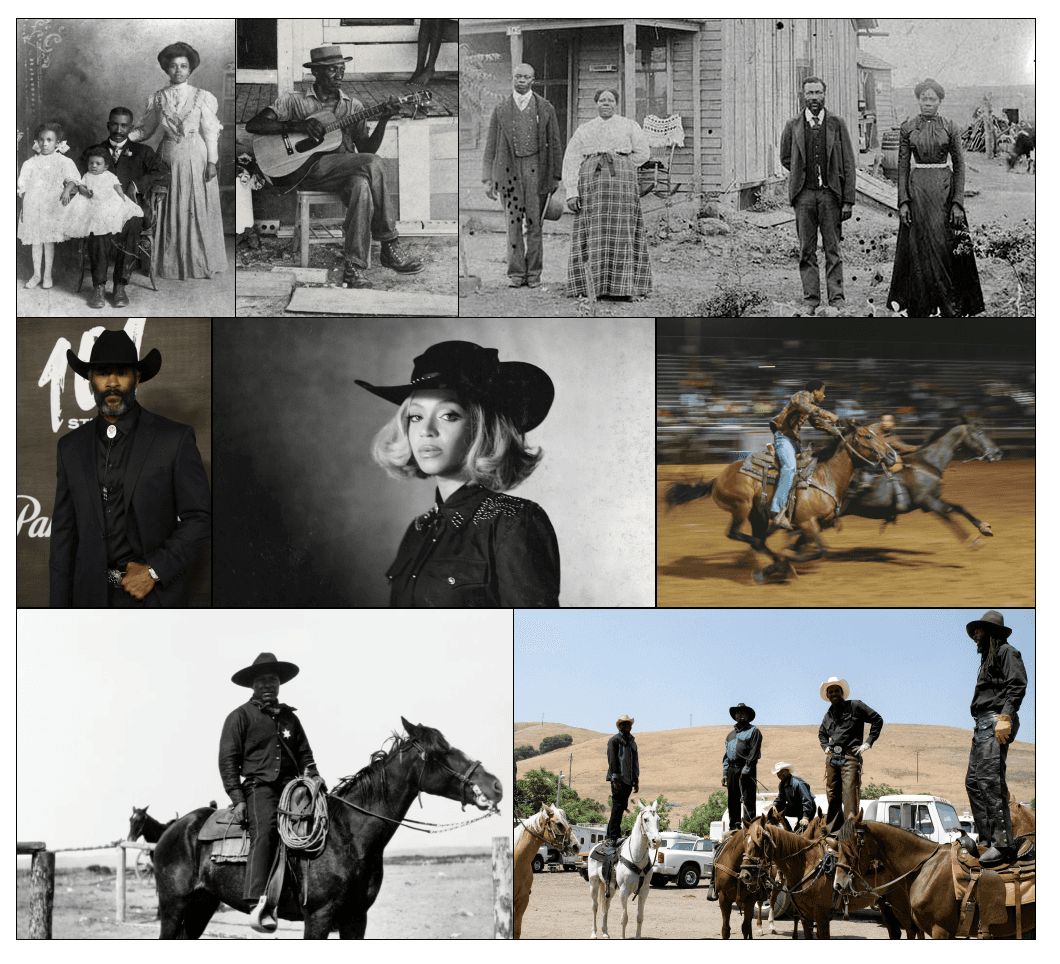
19th Century US Politics and the US Government’s role in pushing the expansion into the West (e.g., political cartoons, The Trail of Tears, The Homestead Act of 1862, The Emancipation Proclamation)
Historical accounts of Black-founded frontier towns (e.g., Freedmens Village, Blackdom, Dearfield, Allensworth)
Origins of Black cowboys and the history of vaqueros
Origins of popular instruments used in country, Americana, bluegrass and folk music
Contemporary reinterpretations of Western iconography in music, TV and fashion
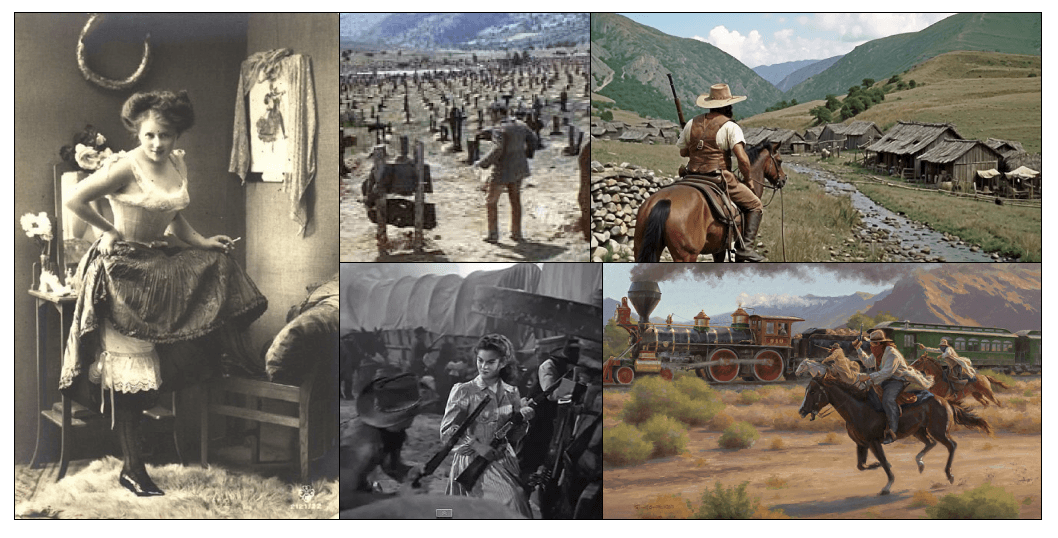
Classic Western films/scenes/shots, film equipment, and pop culture references to the Old West
Key Observations
Many towns shared themes of autonomy, migration, and resilience, despite their vast geographic distances and separation
The visual language of the Old West and American cowboy often romanticizes hardship
Music functions as a modern oral history by bridging past and present
These insights directly informed the project’s narrative structure and visual decisions.
INSIGHT & CREATIVE THESIS
Core Insights
By binding narrative, music, and geography into a unified visual system, cultural memory can be reshaped through spatial storytelling.
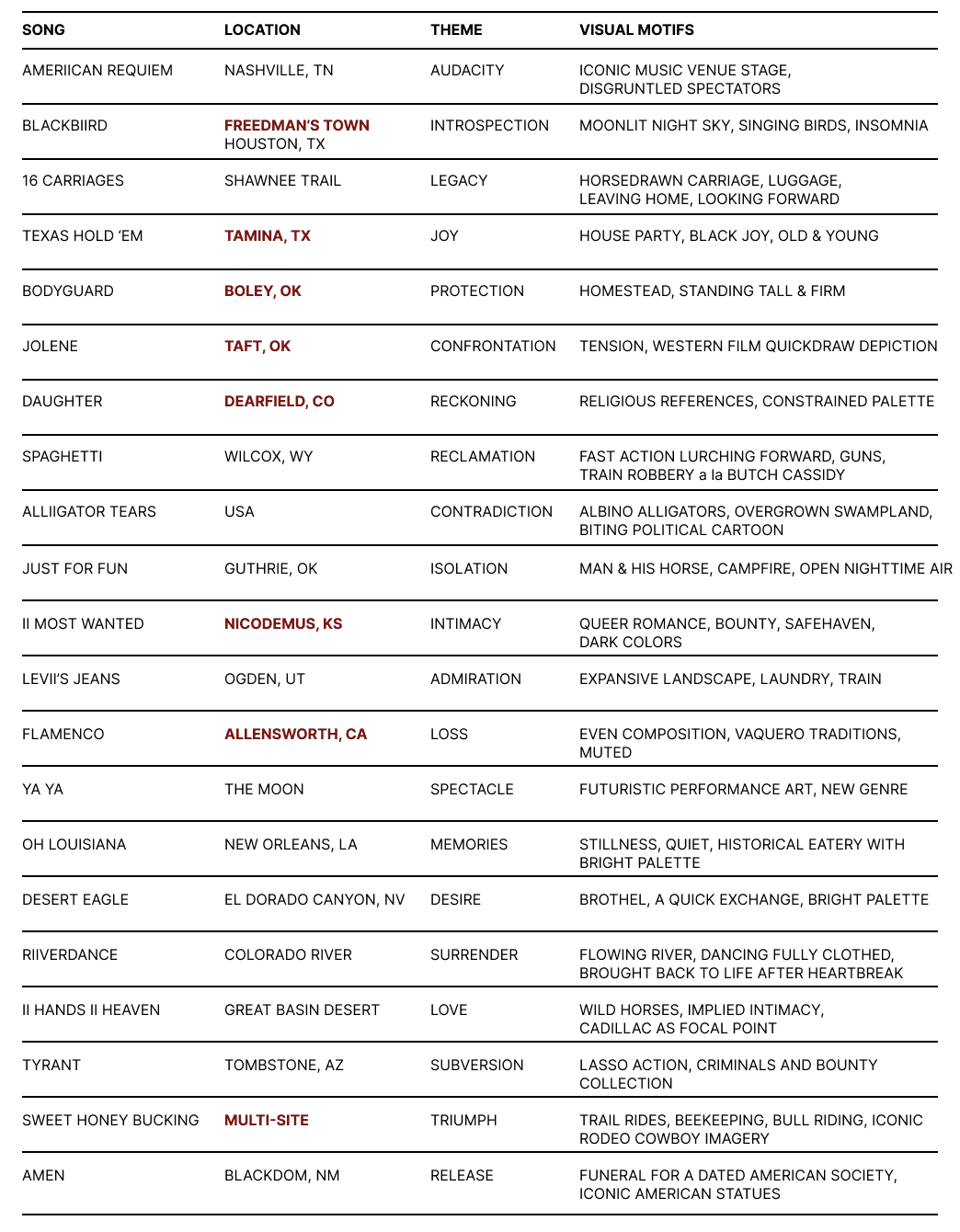
Rather than telling a linear historical story, I designed each piece as a convergence point between a song from Cowboy Carter, allowing the lyrics to drive the visual interpretation, a real location, specified by a particular era/decade, with either Black-led frontier history or significant historical context, and a thematic lens to drive story forward (redemption, resistance, escape, joy, reckoning)
Them Old Ideas Are Buried Here was intentionally structured to operate on multiple levels at once. As a cultural critique, the project interrogates how Western mythology has been constructed and circulated by challenging narratives that simultaneously romanticize the frontier while erasing Black presence, re-centering place-based histories and reshaping collective memory. As a visual archive, it organizes overlooked Black-founded towns into a cohesive, research-informed system, using illustration as an interpretive record where photographic or institutional documentation is limited or absent. And as a repeatable narrative framework, the project was designed to remain open—allowing new locations, collaborators, and formats to be introduced without compromising authorship or coherence. This positions the work not as a closed series, but as a living cultural system capable of evolving across media and contexts.
This framing reflects my broader interest in how designed systems—whether interfaces, narratives, or platforms—author meaning, shape interpretation, and determine whose stories are legible. Each illustration was designed using a consistent narrative system:
EXECUTION & CONSTRAINTS
No AI was used in the visual creation of this work. Each illustration was crafted in Procreate over the course of more than 300 hours across four months during the latter half of 2025.
Because there were no music videos to reference, my imagination wasn’t tainted; I could remain expansive in how the story came to life on paper, yet I had to remain nimble. My process was not free of constraints:
Limited archival imagery for certain locations that have since been deserted like Blackdom and Allensworth
Balance historical accuracy with interpretive storytelling
Maintain narrative cohesion across multiple locations, decades and themes
Design experience around legal limitations (ie. using official audio tracks without express permission from official masters' rights holders)
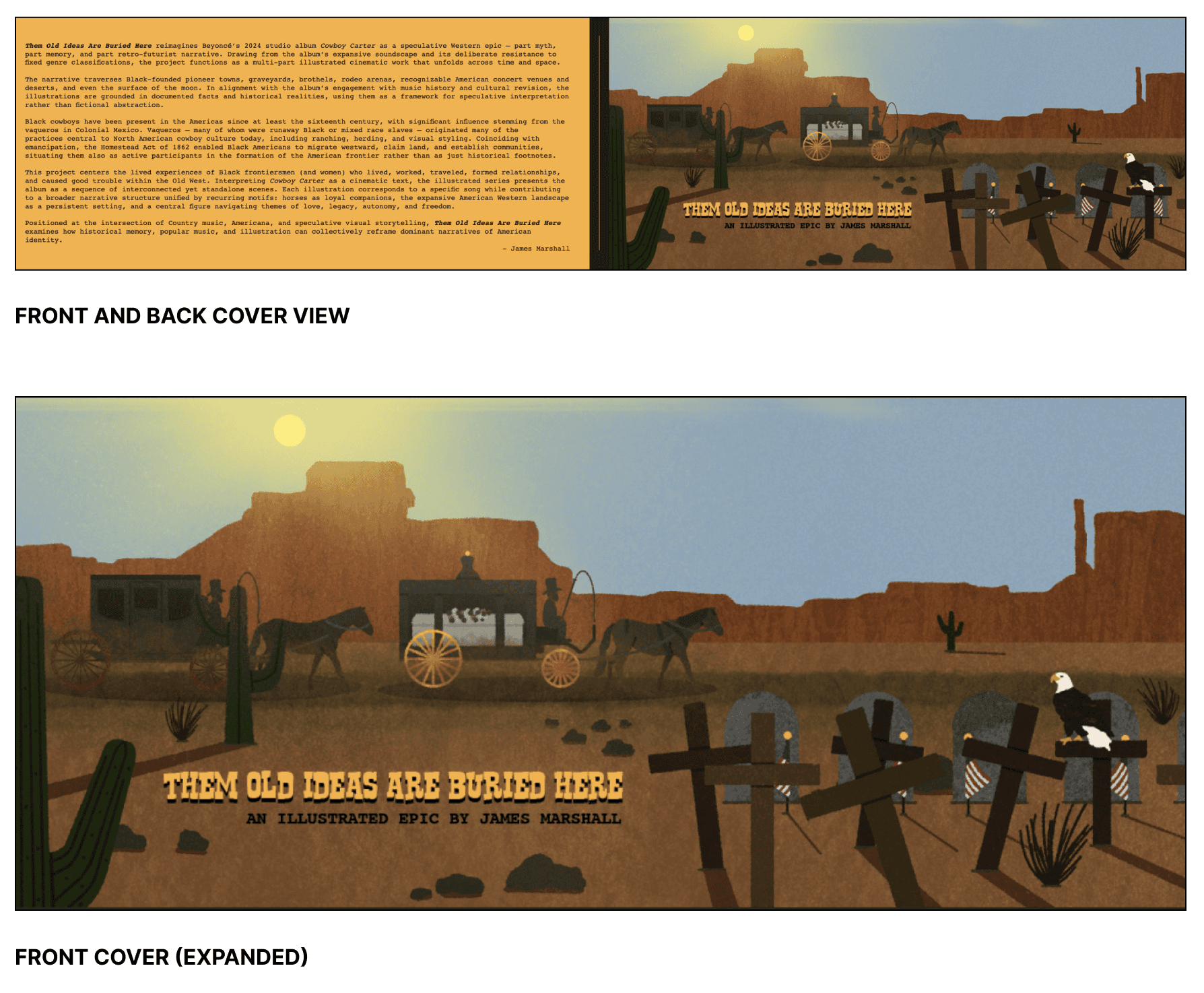
The illustrated epic was initially formatted as a 15” x 6.5” zine or coffee table–style publication, aiming to slow the viewing experience and encourage reflection. It was meant to be sat with from its inception.
VISUAL LANGUAGE & DESIGN DECISIONS
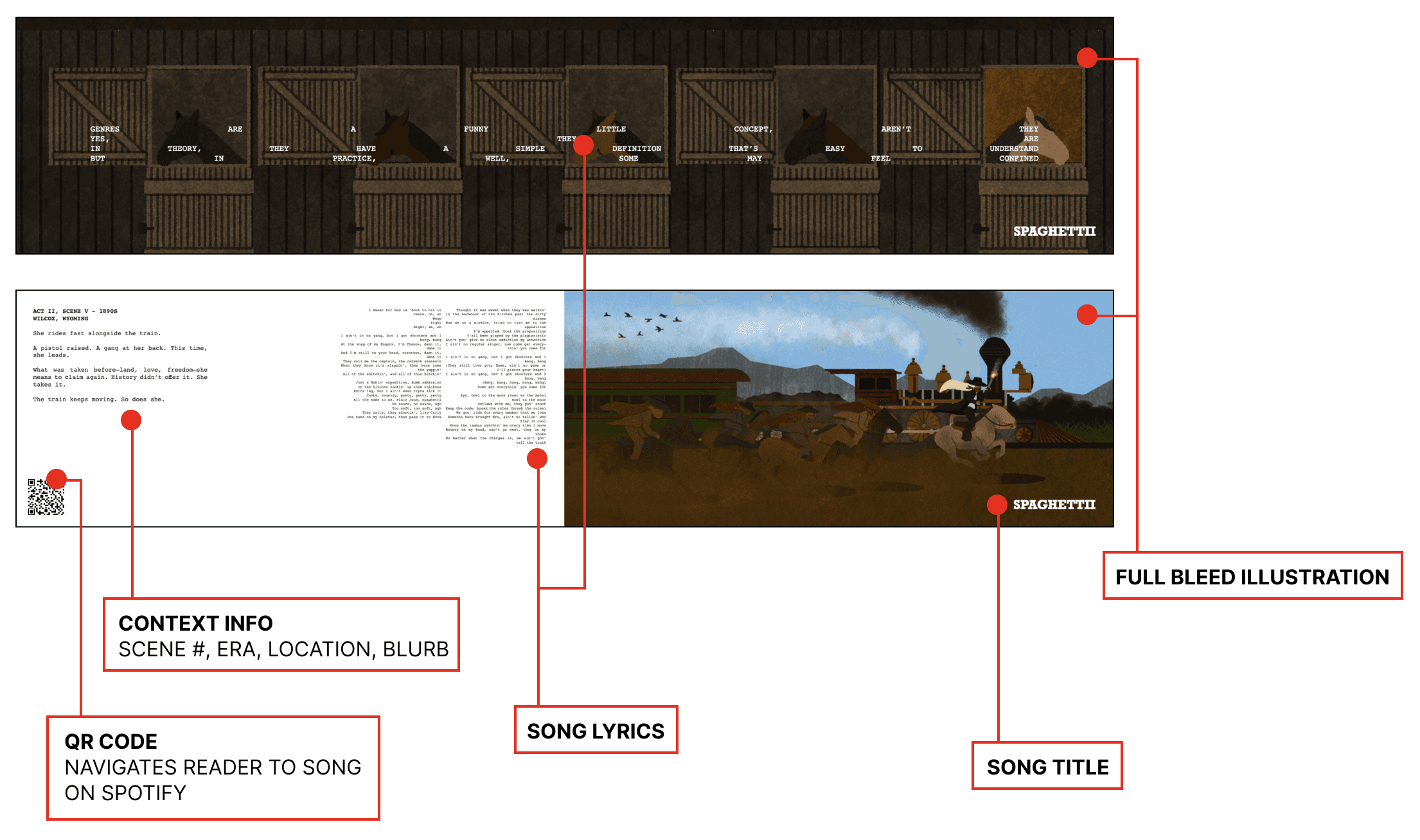
Key design choices for the consolidated zine-style book included:
Embedding a QR code that points to the each song on Spotify, giving the illusion of an immersive experience by allowing readers to absorb the art and listen to the source material simultaneously
Ensuring each spread feels like a film still and annotation by denoting scene number, year and location
Utilizing song lyrics as the narrative reference to related illustration
Minimal design and ample negative space to keep focus on full-bleed art
A legible font that mimics the stylings of a printed movie script
Using full-spread interruptions as natural transition points in narrative
Typography and layout were treated editorially, positioning the work closer to a cultural artifact than a commercial illustration series.
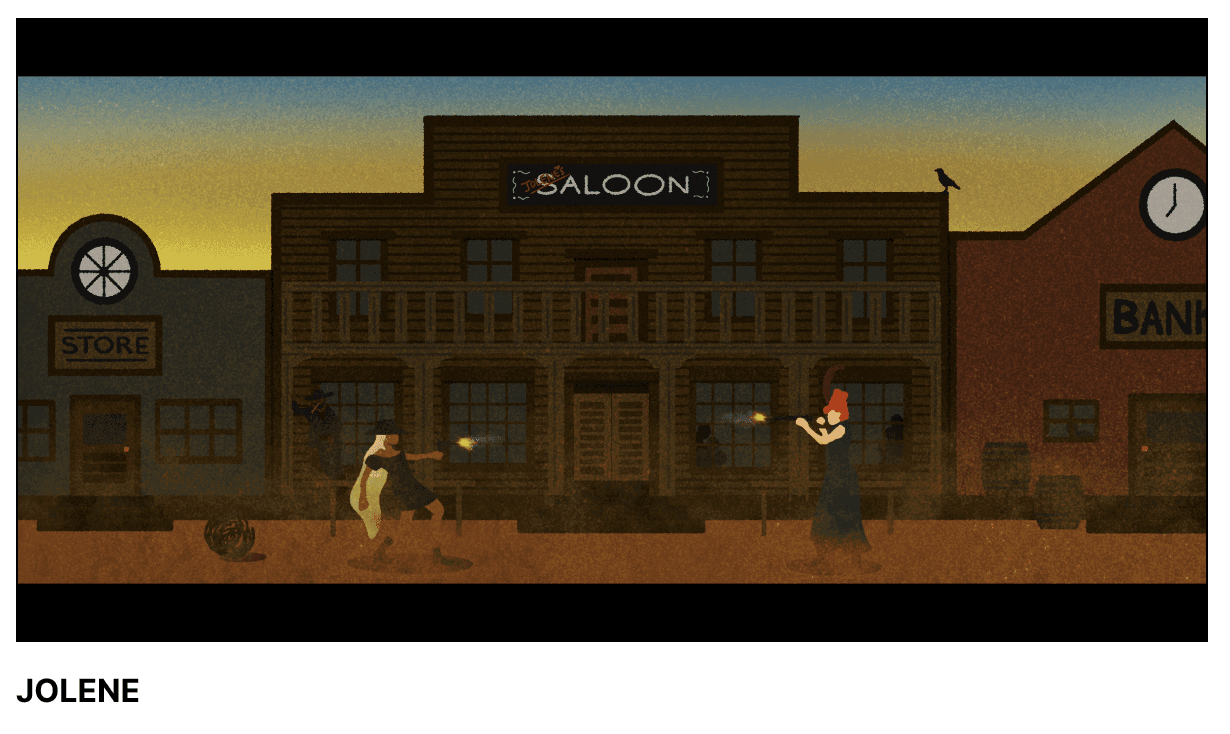
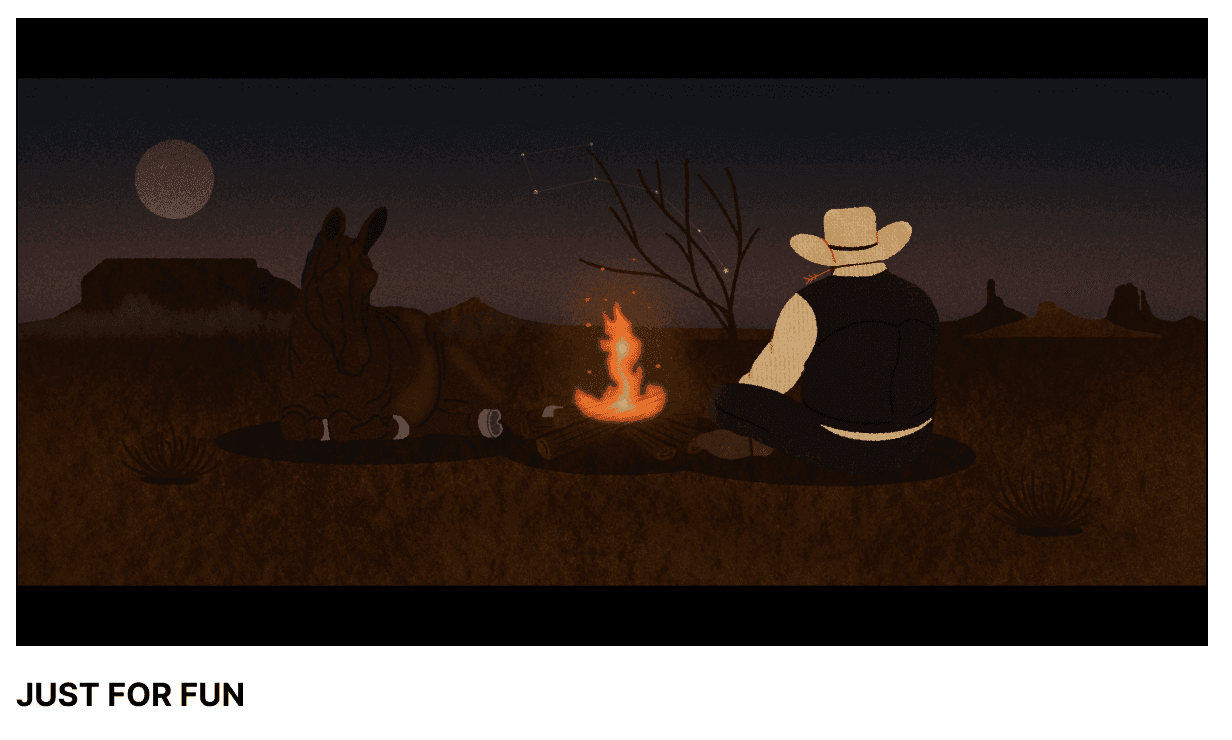
Key design choices for each illustration included:
2:35:1 aspect ratio to mimic a true Western film filmed on a cinemascope or panoramic camera (ie. the inclusion of the black bars)
A rich color palette to mimic viewing the American frontier in real-time
Compositional weight placed on setting to reinforce place as protagonist
Depiction of classic Western film scene setup or trope (ie. quickdraw duel, train robbery, hangman/bounty hunter, etc.)
Stylized figures to suggest universality without erasing specificity

TURNING IT INTO INTERACTIVE MEDIA
When I finished the illustrations, I was satisfied with the outcome, but the work felt incomplete still. I struggled with how to turn it into something people could interact with, but the idea of an interactive digital map linking place, story, and sound stayed top of mind. That is what I set out to explore for its next iteration.
My goal was to build an illustrated narrative device that reinterprets research rather than just illustrating it literally, and I wanted to use the idea of something spatial to organize the story rather than using a linear list.
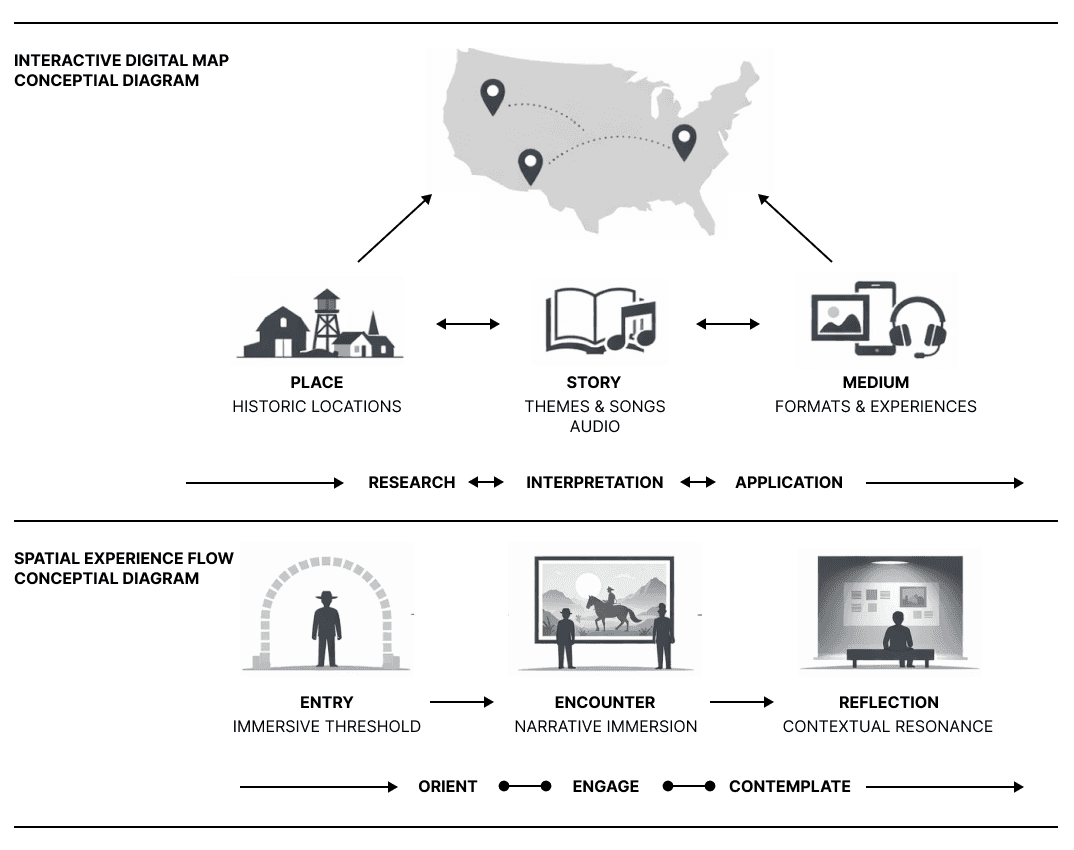
Build Process
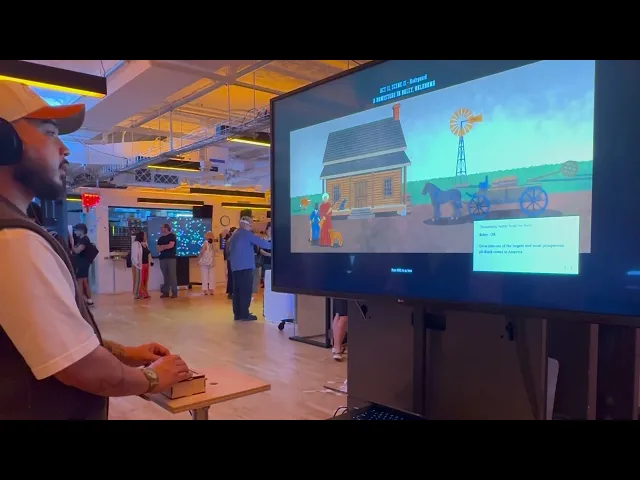
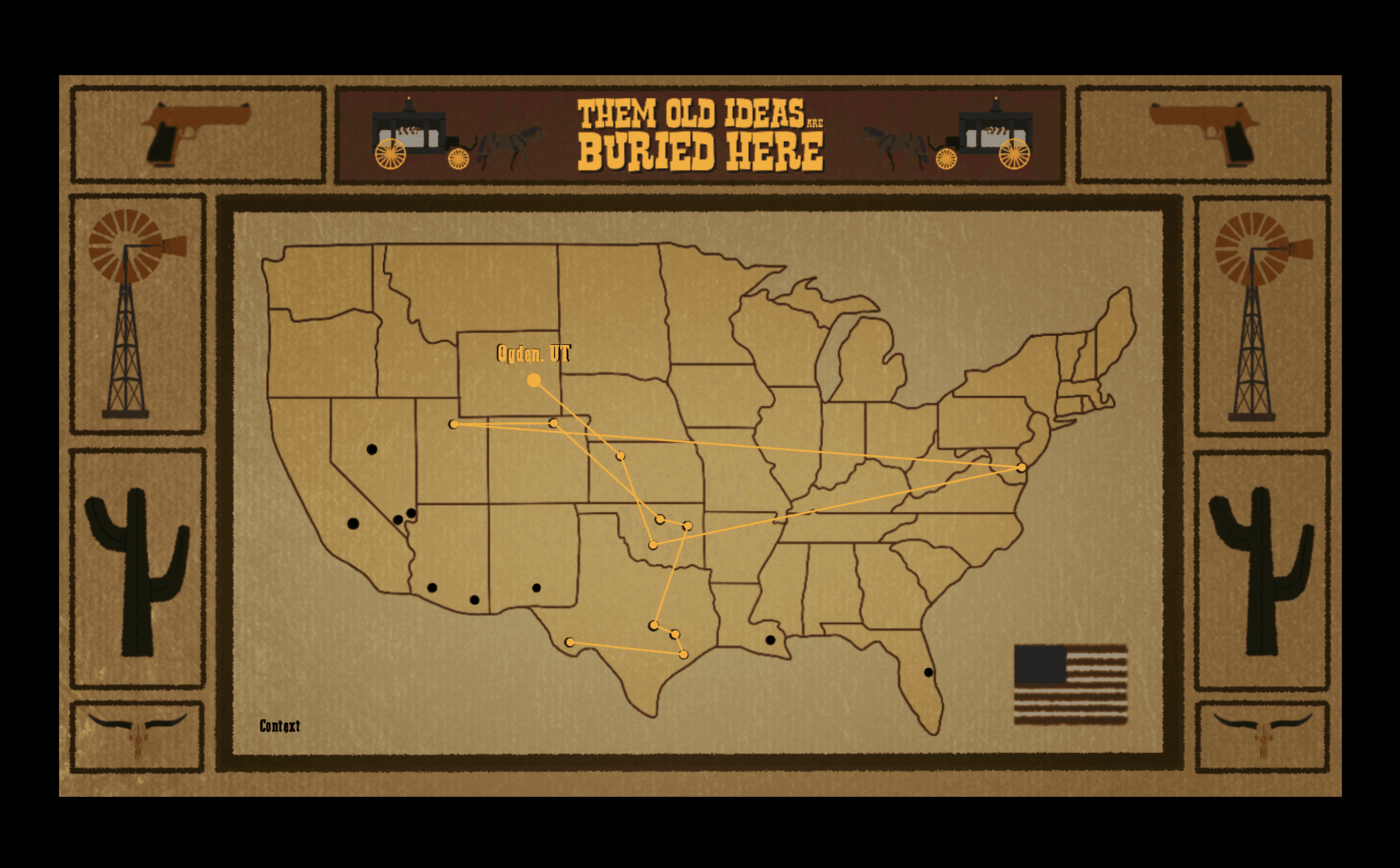
By combining p5.js with physical computing, I finally had the tools to bring the next iteration of this creative vision to life. You can read more about my creative coding process here—ultimately, this library allowed me to create something that users could sit with, sit back and take in all the layered information through an art lens. I built a navigable map that marks users’ specific paths through the experience and presents (and reimagines) the music in an interesting, bespoke way.
I user tested this extensively, and this process showed where improvements could be made. This impacted how users oriented themselves to the map and understood what places they’ve already visited, and it ultimately led me to depict the map as a real-time trail: the connection points would be made between cities as each one was visited, so this added to the interactivity feeling. I also added a Context window to give users a purview into the pieces intent from the beginning.
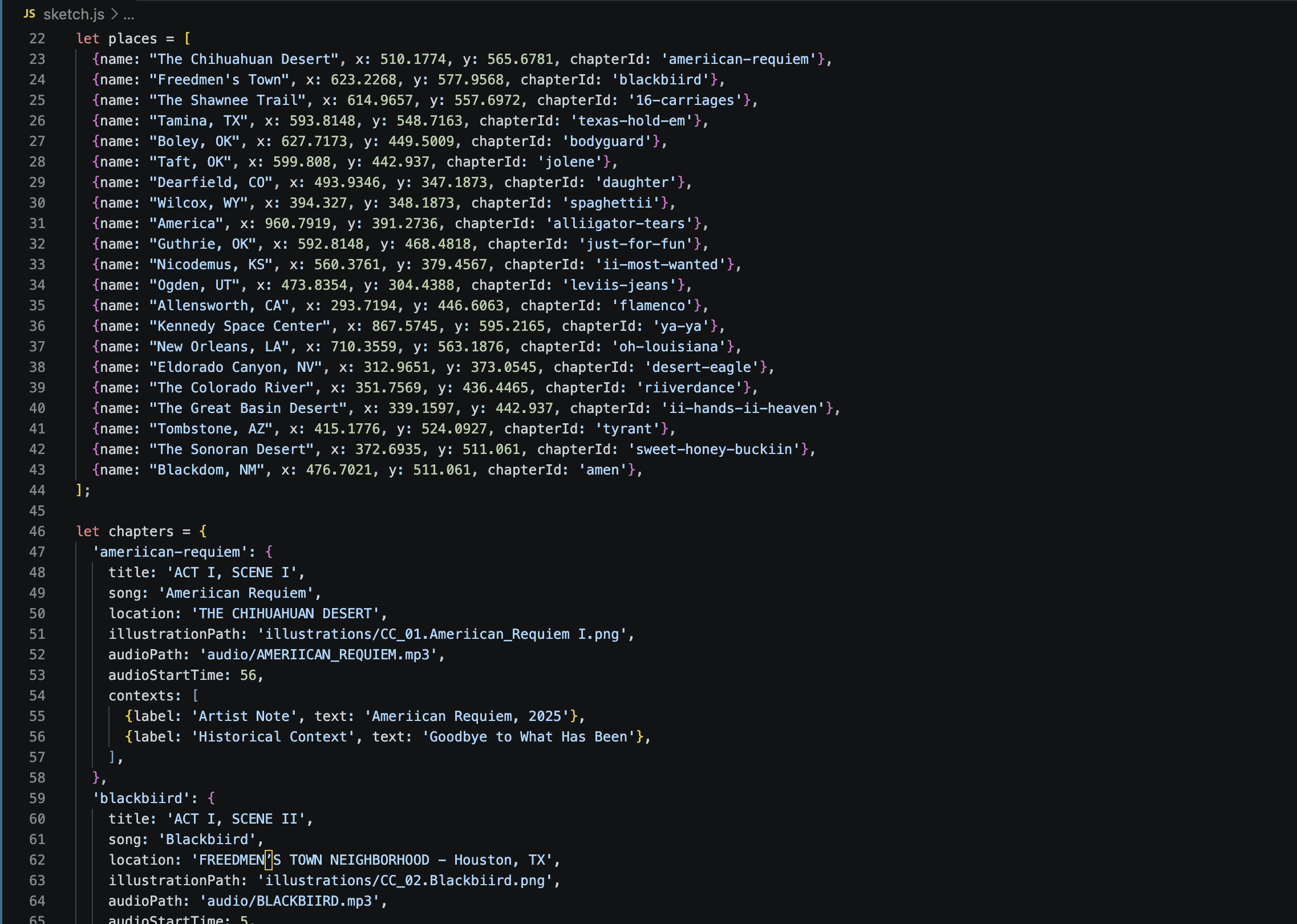
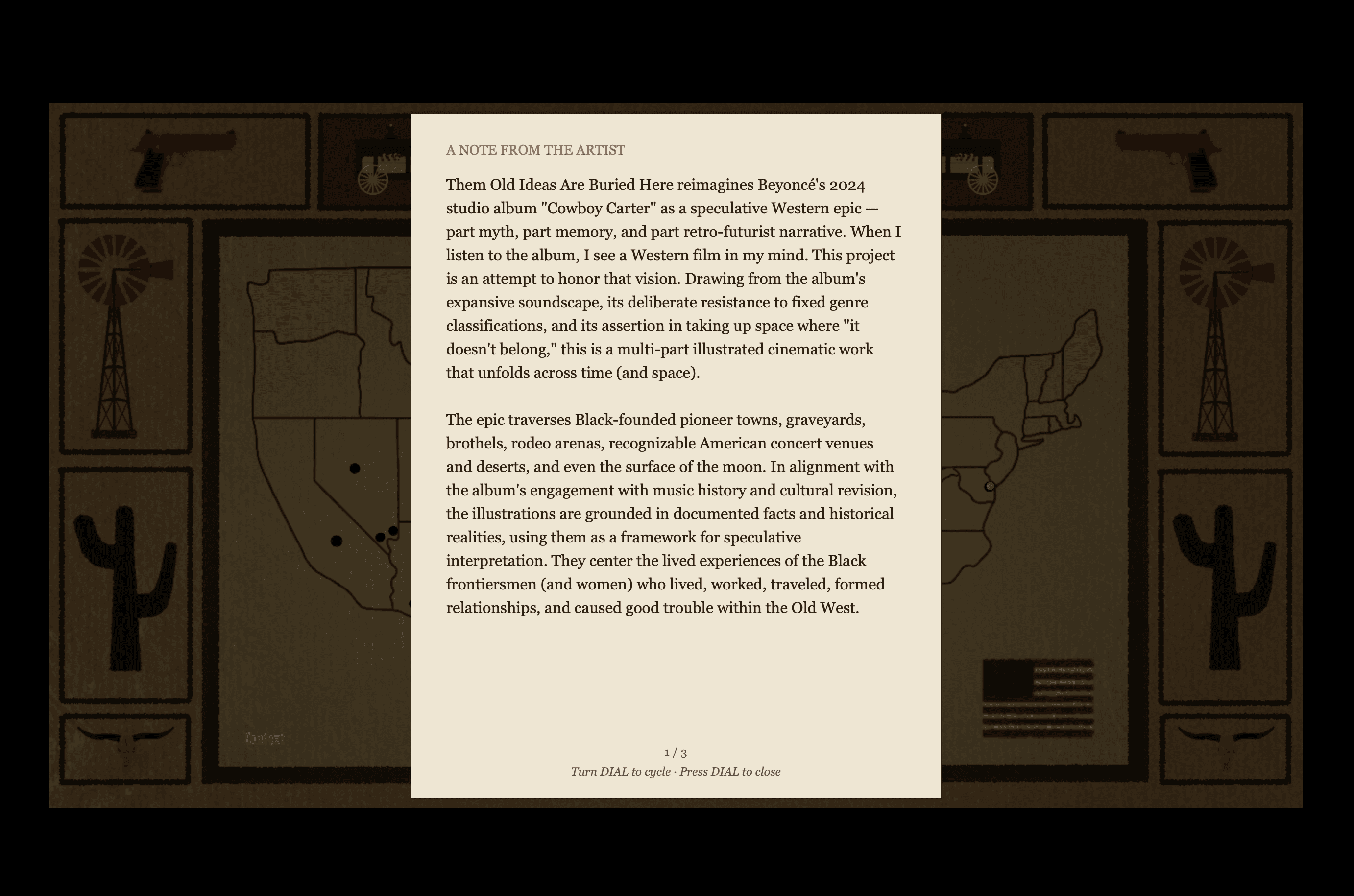

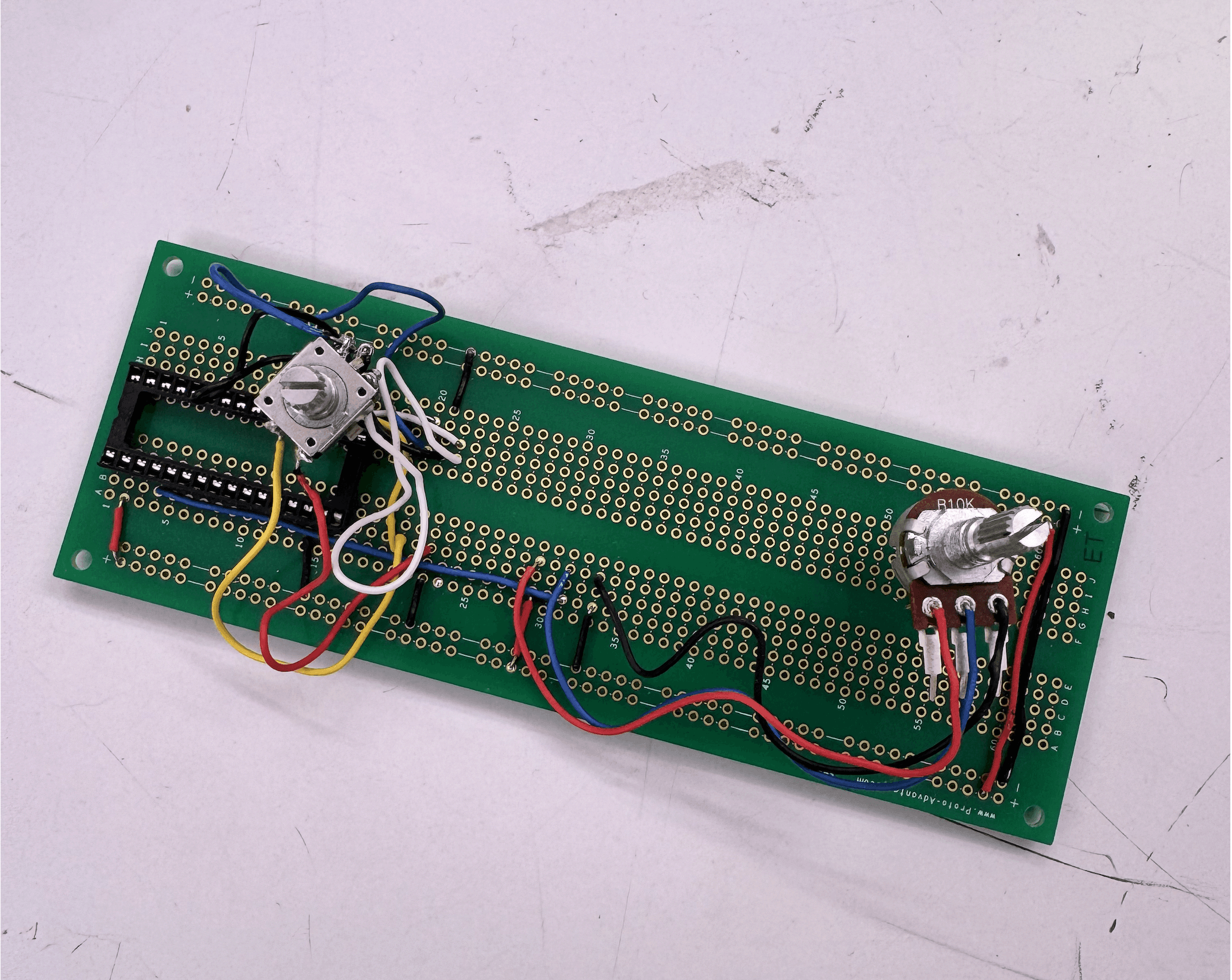
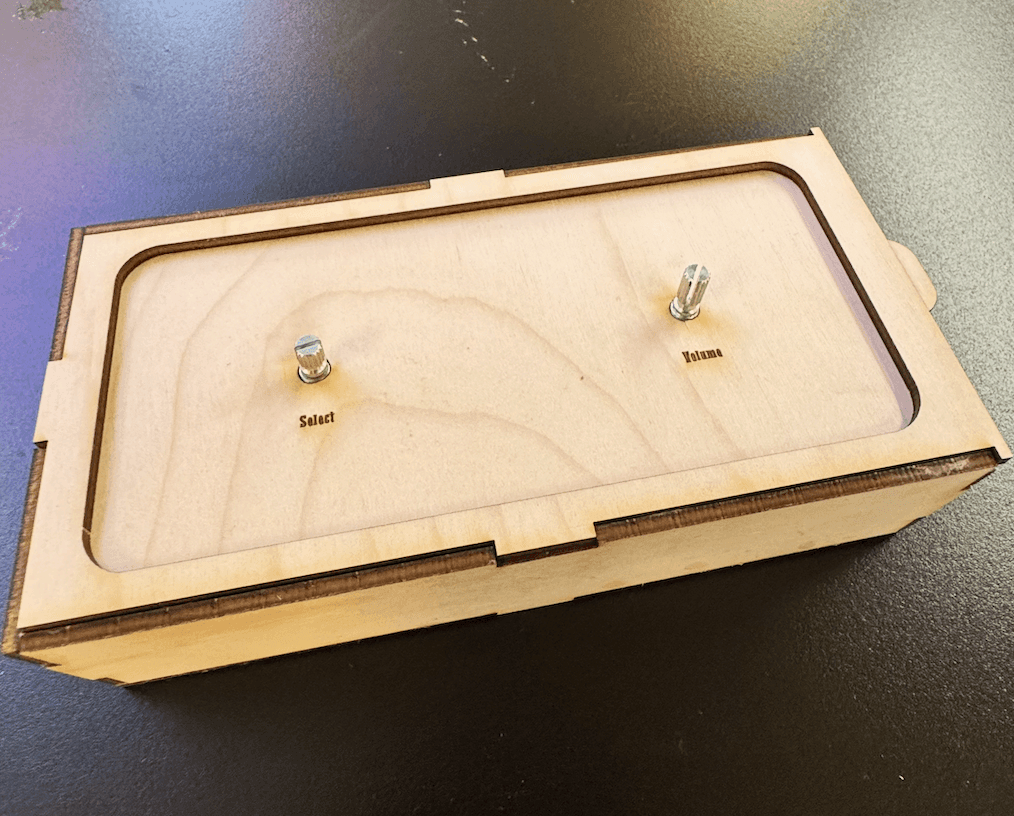
There was also the opportunity to build upon my physical computing skills by creating my own navigation device. I wanted users to experience this work outside of a traditional point and click paradigm, and I wanted whatever tool I used to be themed and practical. Because the narrative takes place in the Old West, I wanted the users to feel as though they’re conducting a train through the same railways. This prompted the idea of having a simple device that looked like what I believe to be an old train conductor mechanism from the late 1800s. It has just two knobs: a rotary encoder for navigating/scrolling/selecting and a potentiometer for volume—that’s it.
On the map screen, you use the dial to choose your next location and pressing it takes you to the scene. On the illustration screen, similarly, you use the dial to scroll through the narrative and contextual information and pressing it takes you back to the map.
There were a few hiccups when building this out though. In order to move from the prototyping stage using a breadboard, I had to transfer my configuration to a perfboard. Getting the rotary encoder’s sensitivity levels right took some troubleshooting, but I got there eventually. Soldering also proved to be a time-intensive and tedious process, and after many attempts at getting things in their right places on the circuit board, it was finally time to enclose. Using a laser cutter provided its own lesson in thinking ahead, but adding this skill to my toolset will come in handy in the future, no doubt.
OUTCOME, REFLECTION & FUTURE ITERATIONS
Reception
I presented this work at my Show & Tell showcase for my Low-Res Interactive Media Arts masters program at NYU’s Tisch School of the Arts in August 2026. Over 200 visitors turned out for the event.
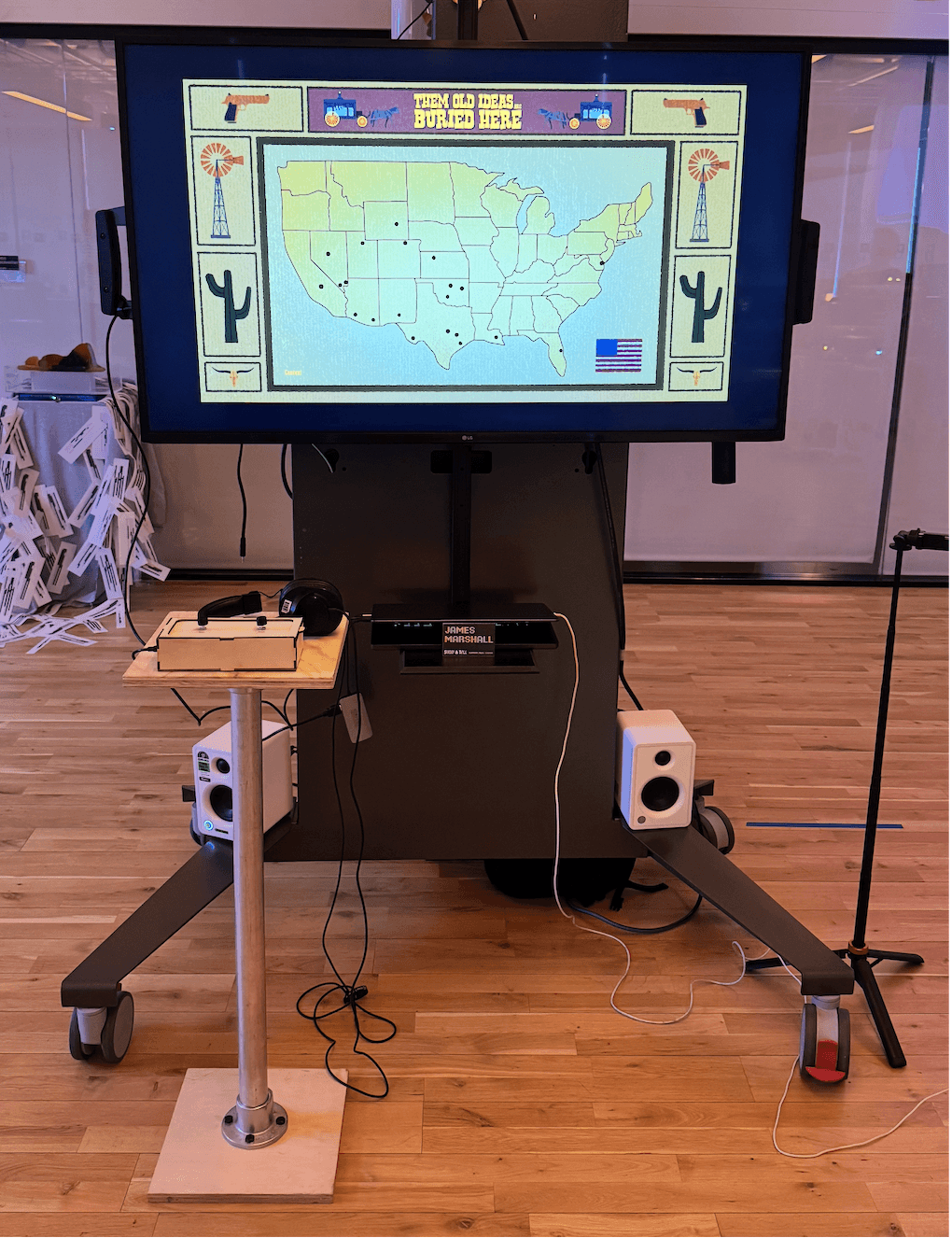
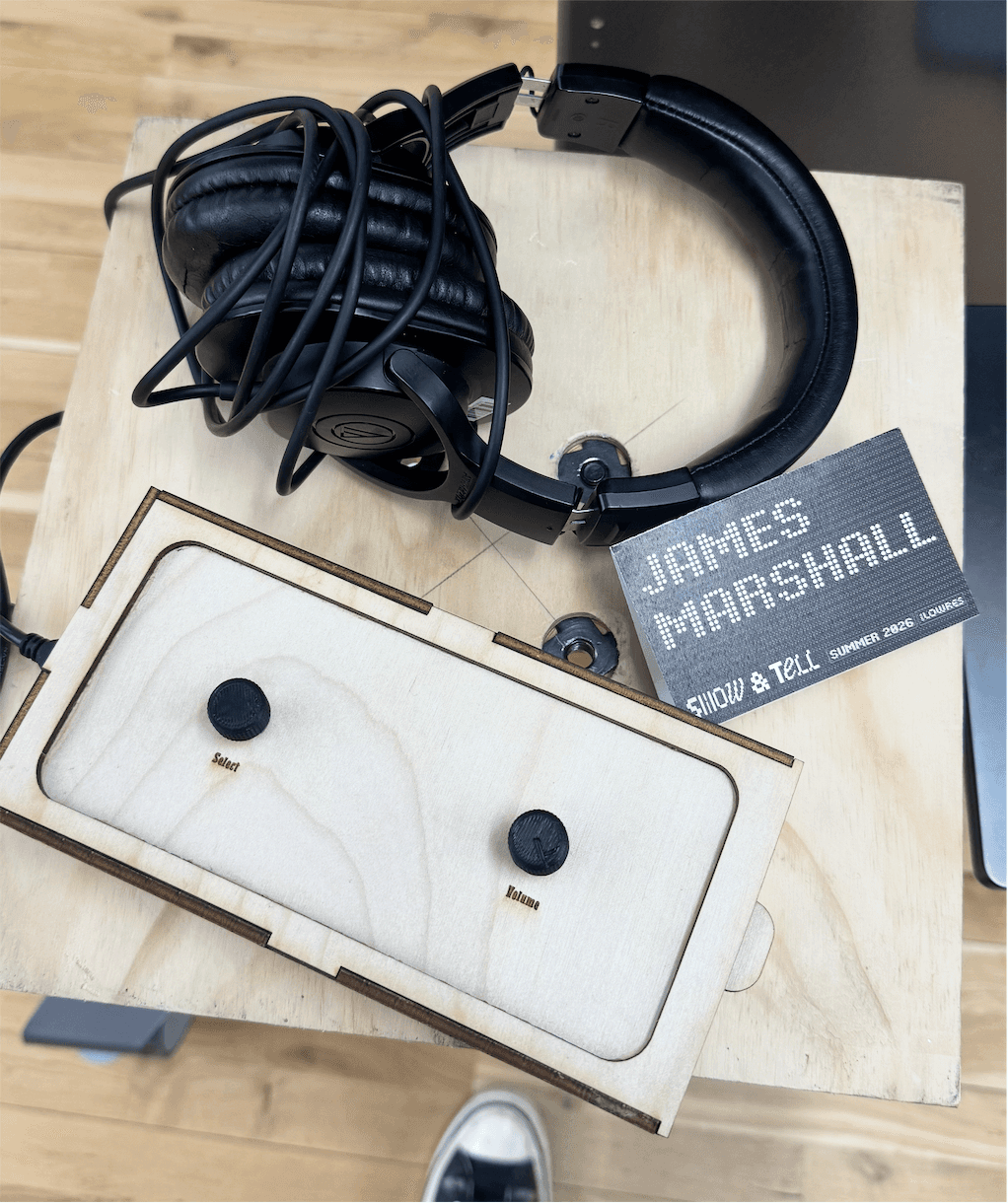
The response I received from participants was astounding, and people were not only impressed by the illustrations and presentation quality, they were enamored with the thinking and research that went into it. It also helped that I used Beyoncé’s Cowboy Carter as the music powering the experience. The source material was rich and provided familiarity with many of the participants. The piece generated conversations with museum and academic contacts about future development.
“I love how you turned something passive like listening to music into something that piques curiosity.”
“This is the work that requires an entire team at a museum.”
“This is nuanced work presented in a way that totally reimagines one medium and tells a story through another.”
The Next Iteration
I intend to continue to expand on the methodology represented in this project, one that is grounded in research, illustration/visual/graphic art, and physical interactive storytelling. I’m interested in seeing how it applies in other contexts, and the way it’s currently coded, it allows for reusability in other contexts. Swapping in a different subject is largely a data-authoring exercise, not a full rebuild.
What this project does well is it uses world-building to create a speculative world that’s still anchored to documented history, it’s made visual through original illustration, and it’s made legible through the body via physical interaction rather than just reading or just passively watching.
How would I apply this to different source material, a different history, a different world? I’m interested in exploring this further.
WHY THIS MATTERS NOW
This project reshaped how I approach creative direction and authorship in design, and I was successful in shifting from isolated artifacts to interconnected systems. It reinforced the importance of research as a creative accelerant and clarified my interest in building culturally grounded, immersive platforms rather than standalone works.
As cultural narratives continue to be remixed and commodified, questions of authorship, history, and responsibility become increasingly urgent. We need real human stories made by real humans.
This project represents my commitment to building nuanced work that exists across design, business, tech, culture, and systems by using creativity as a tool for reframing how forgotten stories are told and who gets to tell them.
CREDITS
Concept, illustration, research, and interaction design by James Marshall.
Inspired by Beyoncé's Cowboy Carter (Parkwood Entertainment / Columbia Records, 2024). This is an independent, unofficial interpretation and not affiliated with or endorsed by the artist or her label. All illustration, narrative framing, and historical research are original.
Built with p5.js and p5.sound. Hardware interaction via Arduino and the Web Serial API.
Dedicated to the fearless ones who aim to challenge the status quo and flip the establishment on its head.
© 2019-2026 Marshall Creative Group LLC
Studio